Whet and Burr exists for one reason: a dull edge is a habit you can fix. Most knives and tools do not need replacing. They need twenty minutes, the right grit and a steady angle.
We write sharpening and edge care guides for readers in the US and Canada. Kitchen knives, pocket and fixed blades, axes, chisels, scissors and pruners. If it has an edge that belongs in a home or workshop, we cover it.
This page explains what we do, how we do it and who it is for. No origin story, no workshop legend. Just the method and the limits.
Our mission
Why Whet and Burr exists
Most sharpening advice falls into two camps. One camp sells you a gadget and promises a razor edge in seconds. The other camp assumes you already know your stones, your steels and your angles, and talks over your head.
We sit in the middle. Every guide assumes you own a decent knife or tool, that it is duller than it should be, and that you want to fix it without ruining good steel. We name real grits, real angles and real stroke counts. We tell you what you should feel, like a burr caught by a thumbnail, so you know the step worked before you move on.
The goal is not a showpiece edge. The goal is a knife that slices a tomato without pressure, an axe that bites on the first swing and pruners that cut clean instead of crushing stems.
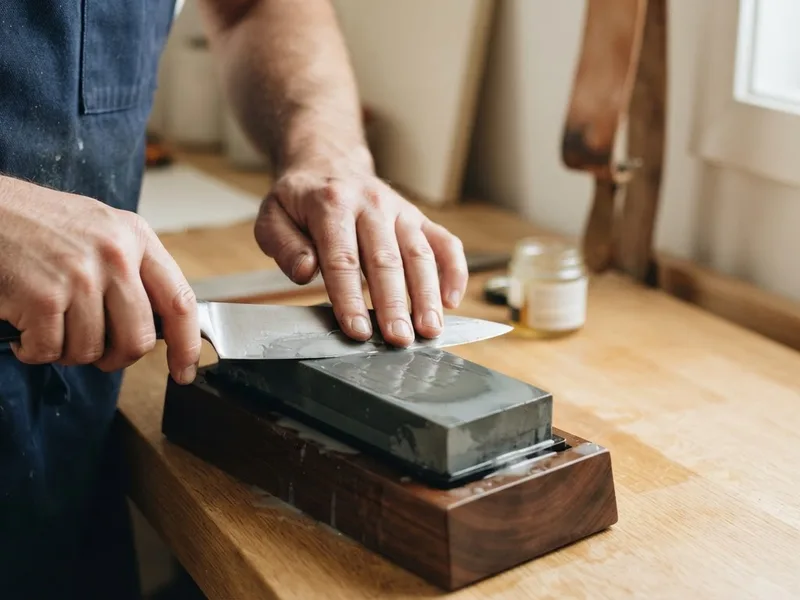
The same bench sequence, every time
Every sharpening guide on this site follows the same order: set the angle, raise a burr, refine through the grits, remove the burr, strop, then test. Learn the sequence once and it transfers from a chef's knife to a chisel to a pair of garden shears.
Repetition is the point. Sharpening is a motor skill, and a fixed routine is what turns your first wobbly session into a habit you can trust. When a tool needs a different approach, like scissors or serrated blades, we say so and explain why.
Every how-to also opens with an At a glance box: skill level, time, tools and the target grit or angle. You know what you are committing to before the stone comes out.
How we work
What you can expect from every guide
Method before products
We explain the product type first, whetstone, honing rod, guided system, and name current models second. Price is talked about in broad ranges, never as a headline.
Grounded comparisons
Comparisons stay tied to steel hardness ranges, edge angle, grit range, budget and how often you actually cook, hunt or carve. Not lab numbers for their own sake.
Honest limits
We say when a method is wrong for the edge. A thin Japanese blade belongs on stones or with a pro. Deep chips, broken tips and reprofiling sometimes need a repair shop, and we tell you when.
Clear boundaries
We cover knives, axes, chisels, scissors and pruners. Mower blades and chainsaw chains go elsewhere; they need different equipment and we do not pretend otherwise.
Who it is for
Written for people who use their edges
Most of our readers are home cooks with a German or Japanese chef's knife that used to glide and now slides off onion skin. If that is you, start with whetstones and angles; that is where the biggest gains are.
We also write for hunters, anglers, campers and everyday carry users who need an edge that survives field work, and for woodworkers and gardeners whose chisels and pruners dull quietly over a season.
What connects all of you is the same thing: you own decent steel, you are tired of dull edges, and you want clear choices on grit, angle and method that protect what you paid for. You do not need to become a collector. You need a working edge and the judgment to keep it.
Whet and Burr in short
- One bench sequence across all guides: angle, burr, refine, deburr, strop, test.
- Method and product type first, model names second, prices in broad ranges.
- Honest limits on chips, serrations, thin Japanese edges and pro-level repairs.
- Coverage: kitchen, pocket and fixed blades, axes, chisels, scissors and pruners in the US and Canada.
- Every how-to starts with an At a glance box: skill, time, tools, target grit or angle.
Bring us your dull edge
Have a sharpening question, a tricky edge or a topic you want covered? Send it our way. A specific question gets a specific answer.